Two-level local government: Science, technology, innovation and digital transformation improve operational efficiency
08 Nov, 2025
The Ministry of Science and Technology issued Document No. 2827/BKHCN-CVT dated June 30, 2025, directing telecommunications enterprises to ensure transmission capacity and connection bandwidth to serve the operation of the 2-level local government model from July 1, 2025. At the same time, complete the upgrade of the analysis and statistics system according to the new 2-level administrative location. Publish data on Vietnam's Internet speed according to the fixed broadband network, mobile broadband and 5G mobile broadband according to the new 2-level administrative location data for July 2025 on the website https://i-speed.vn.
Along with that, coordinate with ministries, branches and localities to resolve problems, difficulties and obstacles in the process of implementing administrative procedures and online public services in localities operating under the 2-level local government model. According to Decision No. 2083/QD-BKHCN, the Ministry of Science and Technology has established 12 working delegations with 34 provinces and centrally run cities to grasp the situation of operating the commune, ward and special zone governments; provide guidance, handle; propose and recommend solutions to remove and overcome difficulties and problems in the fields under the management authority of the Ministry of Science and Technology.
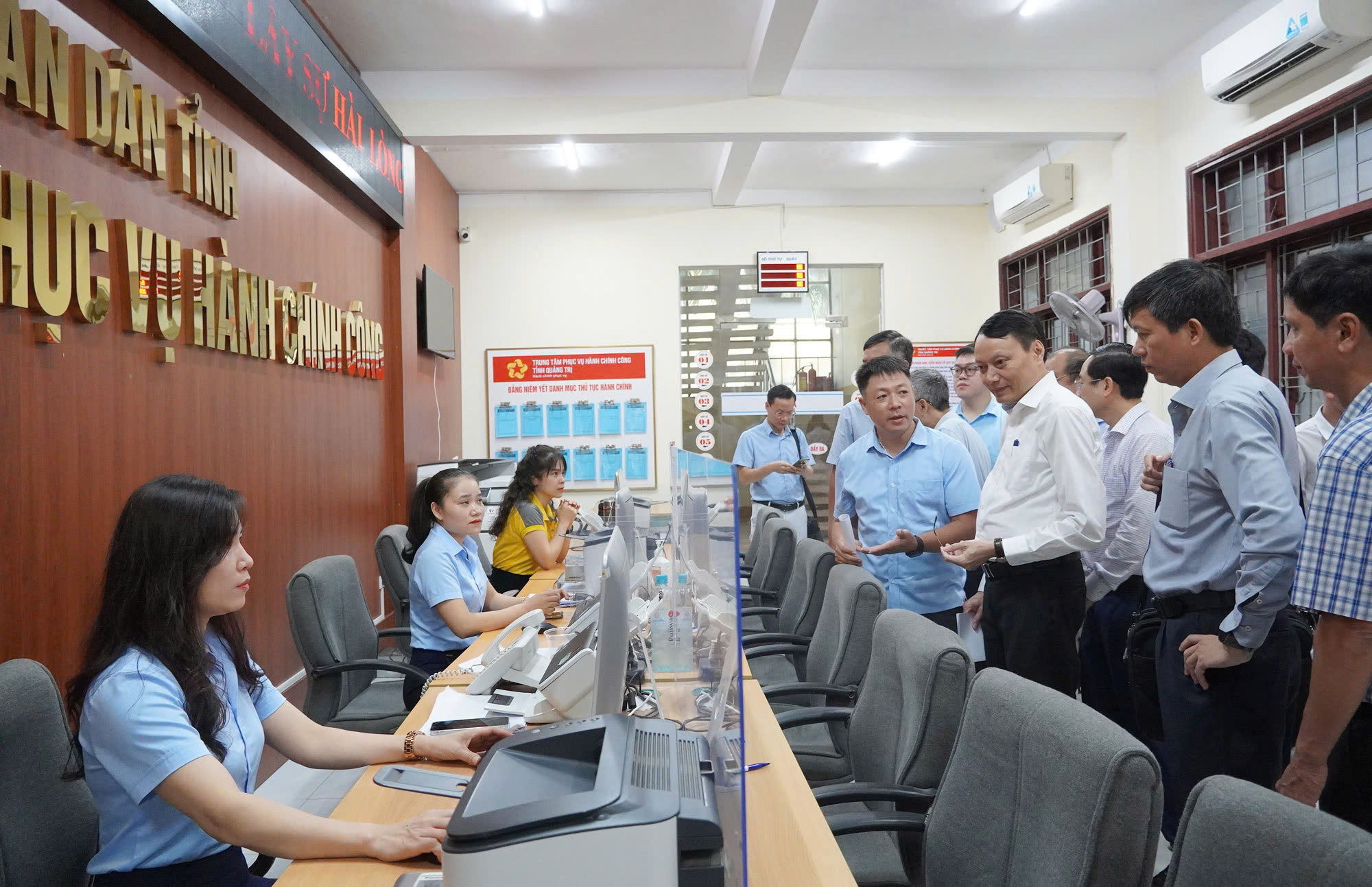
Working group of Ministry of Science and Technology surveyed at Quang Tri Province Public Administration Service Center.
Locally, in the field of post, telecommunications, and digital transformation, the Department of Science and Technology has directed postal enterprises in the province to ensure safety and security in providing postal services; directed telecommunications enterprises to ensure communication during the rainy season and major holidays. Specifically, in Cao Bang, the Department of Science and Technology has urged telecommunications enterprises to continue to quickly deploy mobile coverage to villages and hamlets with low signal; postal and telecommunications enterprises have arranged 448 personnel from Viettel, VNPT, the Provincial Post Office, and Viettel Post to support 56 new communes and wards after the merger to operate the province's shared information system, ensuring unity, synchronization, and connectivity throughout the entire political system from the central to local levels, in accordance with the 2-level government model.
In Hai Phong City, the Department of Science and Technology proposed that the City People's Committee report to the Ministry of Science and Technology to support the pilot low-orbit satellite telecommunications service. At the same time, strengthen the deployment of 5G, IoT, and fixed broadband Internet infrastructure with speeds above 1Gb/s; implement solutions to overcome limitations related to infrastructure and quality of telecommunications services at the City Political - Administrative Center. In August, enterprises invested in adding 23 new BTS stations, bringing the total number of BTS stations to 4,757; deploying 30 km of new optical fiber transmission lines.
Hung Yen province issued Plan No. 45/KH-UBND dated August 26, 2025 on deploying 5G and IoT infrastructure in industrial parks and industrial clusters in the province until 2026, and at the same time submitted to the People's Committee a proposal to develop a passive telecommunications infrastructure plan for the period 2025-2030, with a vision to 2035.
Nghe An Department of Science and Technology developed an action plan to implement the postal development strategy for 2025 and a vision to 2030; check to ensure communication in natural disaster prevention; review network security, information security for systems serving the deployment of public services according to the two-level government model.
In Tuyen Quang, fiber optic Internet and mobile information infrastructure has been deployed to 100% of commune and ward centers in the province. The whole province currently has 2,978 BTS stations in operation, including some stations shared between enterprises, and 81 5G stations; telecommunications infrastructure of other enterprises is ready to meet the deployment of 5G network in the coming time. 100% of People's Committees of communes, wards and agencies and units are connected to fiber optic broadband Internet and are connected to a dedicated data transmission network.
In Ha Tinh, the Department of Science and Technology deployed a force of officers and employees to support activities at the public administrative service centers at the commune and ward levels throughout the area, contributing to ensuring the operation of the two-level local government model according to the roadmap. At the same time, the Provincial People's Committee submitted a draft to develop the Task of establishing a Passive Telecommunications Infrastructure Plan for Ha Tinh Province until 2030, with a vision to 2035, and a draft Digital Infrastructure Development Plan for the period 2025-2030 in the province.
In Thai Nguyen, the Department of Science and Technology organized a training course for members of the Community Digital Technology Teams at the People's Committee of Dinh Hoa Commune, the first commune in the province to organize training according to the request to establish a Community Digital Technology Team in each commune and ward to contribute to the effective implementation of the two-level government; this is an important step in the journey of digital transformation, building a smart community and increasing access to digital technology for people.

Community digital technology team contributes to the effective implementation of two-level government.
In Lao Cai, a dedicated data transmission network has been deployed to 100% of state agencies at the provincial, district and commune levels; 100% of state agencies and one-stop shops at all levels have LAN networks and IT infrastructure that meet standards, facilitating the process of building e-government, deploying online public services and the tasks of Projects 06 and 08.
Quang Tri increases investment in telecommunications infrastructure, builds multi-purpose BTS stations, eliminates mobile signal blank areas, coordinates technical acceptance of provincial source information systems, and provides training for communes. Hue City deploys 166 public service agent points to guide and support online public services, maintains post offices at old commune and ward headquarters, and deploys environmentally friendly BTS station model routes.
Da Nang digitizes administrative procedures, builds a digital infrastructure development plan for 2025–2030, and implements the elimination of blank spots and signal dips; Quang Ngai reviews transmission capacity and connection bandwidth to serve the 2-level government model; Khanh Hoa establishes a passive telecommunications infrastructure plan for 2025–2030, with a vision to 2035;
Gia Lai implements the Postal Development Strategy, economic and technical norms for guidance, reception, and digitization of documents; mobile coverage and mobile broadband reach 100% of commune and ward centers and 99.9% of villages and hamlets, ensuring communication and telecommunications and internet network services to effectively serve the work of arranging the apparatus, administrative units, and organization of 2-level local governments.
In Dak Lak, the Department of Science and Technology coordinates with telecommunications and information technology enterprises to overcome signal depressions, specifically in Buon Sa Bok (Nam Ka commune) with 114 households and Sub-area 249 (Ea Sup commune) with 30 households. Lam Dong Department of Science and Technology advised the Provincial People's Committee to issue a Program to promote and support people, businesses, and business households to have a safe online presence with digital services using the national domain name ".vn"; undergrounding and renovating the telecommunications cable system in the period 2025-2030; Can Tho Department of Science and Technology signed a cooperation agreement with Vietnam Posts and Telecommunications Group and Viettel Military Telecommunications Group on the digital transformation strategy in the period 2025-2030.
Dong Thap applies economic and technical norms for public postal activities, connecting specialized data transmission networks to serve the arrangement of administrative units and deploying a 2-level local government model, covering 100% of hamlets and villages with 3G/4G and FTTx optical cable; Tay Ninh implements an online presence program with the national domain name ".vn", developing 5G and IoT infrastructure in industrial parks by 2030; Ca Mau deploys the provincial digital infrastructure development plan for 2025–2030; Ho Chi Minh City develops BTS station network, 5G network and IoT for the period 2025–2027.
Thus, the support of science and technology, digital infrastructure and post and telecommunications helps the two-level local government operate smoothly, improve management efficiency, better serve people and businesses, and at the same time promote digital transformation and local socio-economic development.